Thursday, December 2, 2010

Compaq V6000 Coprocessor

Obey, ☮ & Revolution

Post
The depth of today was taken from an article I wrote last June, published on the webzine Art, Culture Part of why I work in April 2009. I think it is appropriate to speak of an artist who has recognized the dangers of so-called "intellectual fascism", the thought of plagiarism and induction of induced needs that make us slaves to a big brother and fully approved.

Et voila:

Frank Shepard Fairey, best known as Obey, is an American contemporary artist.
His artistic production in series began in 1989 on the walls of Rhode Island, then become a true global phenomenon. Today, after fourteen arrests, several processes at breakneck speed and flight, Shepard Fairey is one of the most popular street artist and designer of the United States, whose works are exhibited in prestigious museum collections, such as the New Museum of Design in New York, San Diego Museum of Contemporary Art, the Museum of Modern Art in San Diego and the Victoria & Albert Museum in London.

Born in 1970, Fairey, started drawing the first punk skateboard stencils and stickers in high school, until re-evaluating the concept of adhesive, intended as means of personal expression, rather than how to represent a band, a company or a movement.
His artistic experience begins with the production of its first sticker, dedicated to Andre the Giant, wrestler originally from France, at that time peak of his career: his face is quickly transformed into a stylized portrait is Andre The Giant Has a Posse, accompanied by a disturbing written in capital letters "OBEY."
In the manifesto drawn up in 1990, explains Fairey OBEY sticker campaign as an experiment in Heidegger's phenomenology, which is to allow things to occur in pure ontology being, enabling people to see clearly what is before their eyes. The adhesive has no meaning in itself, but exists only to cause people to react and look for a meaning in the cartoon, the various reactions and interpretations of the observers reflect their personality and sensitivity. Obey Giant campaign inspires even art critics: the New York Carlo McCormick, connects to the overwhelming power of advertising:

"We live in a world overloaded with advertising. There is no way to avoid them when you walk down the street. [Obey Giant] tells you to buy and obey, but do not know what to buy or who to obey. Works al livello elementare di catturare l’attenzione delle persone e fargli chiedere cosa sia un segno. Una volta che inizi a chiederti cosa sia quel segno, allora forse puoi iniziare a mettere in discussione tutti i segni”.

Palese ed inquieta fonte d’ispirazione di Obey è il film cult They Live di John Carpenter, in cui il protagonista, tramite degli occhiali speciali, riesce a decodificare i cartelloni pubblicitari che contengono messaggi subliminali.


“Ho creato il progetto Obey per costringere le persone a confrontarsi con themselves. My impression is that many do not understand that in life as individuals act obedient and disciplined. Perhaps my posters may make them reflect on their situation. And many could not tolerate this. "

inevitable glimpse of a political and social meaning in the words and actions of Obey. Political commitment that has become evident in 2008 when Fairey created the series of posters in support of the candidacy of Barack Obama, including the iconic portrait HOPE and PROGRESS, considered by art critic Peter Schjeldahl, "the most effective political posters in the U.S. since Uncle Sam Wants You '. "


Despite the identification by the system of official art, with exhibitions in museums and galleries, and the execution of merchandising business, the intent of Obey remains to be food for thought social, triggering the collective consciousness. Is proof of his recent participation in the project www.artistsforpeaceandjustice.com the proceeds from the sale of the works are to support the earthquake reconstruction work in Haiti.

To those interested to read the whole article, here's the link: obey-the-Emilia-Mellon

Wednesday, December 1, 2010

How Much To Hire Pinky

Lynch musician, Burton at the MOMA on books of literature and Monicelli

Beginning this December, dedicating a post to the last trials of some of my favorite directors.

Prime creative genius in question is David Lynch, an eclectic artist, already try your hand at writing and painting. After the memorable television series Twin Peaks (I still wonder who killed Laura Palmer ...), the surrealist film (Blue Velvet, Lost Highway, Mulholland Drive, to name a few), the paintings and sculptures on display at the Milan Triennale of 2007 with "The air is on fire, "it is time to experiment with music.

The first single launched the I-Tunes by Lynch called "Good Day Today", and anticipates the album will be distributed by the British Independent Sunday Best.

the director says: "In all my films have always been very involved with what you feel. The creation of this album is a natural extension of my love of sound and music. I am very happy to be with the Sunday Best for the release of "Good Day Today" and "I know." This seems a good partnership - and I can not wait that everyone has a "Good Day Today".

Here is the song in question:

As in his films here show a strong surrealist dream sequences of vocoder and electronic sounds extremely interesting. I personally remember the pieces more "cheerful" Silent Shout The Knife, 2006. Disperse the next single will be convincing if, in the meantime I look more forward to his next film!

The second film I want to write is Tim Burton. His early works I Talma liked enough to indicate one of my absolute favorites, but some movies now, it seems that Timothy is rest on our laurels of success, although he himself declares:

"To go there just for Hollywood work, I no longer live in Los Angeles, I do not like high society, I feel close to my characters, and poorly integrated into conflict with society: I tend to internalize everything, are closed, lonely and angry. "

E 'needless to say as I adore his films, especially Beetlejuice - Faerie pig, Batman, Edward Scissorhands and Big Fish ... and the Chocolate Factory and then the most recent Alice in Wonderland, although it is worth seeing, personally I have fulfilled my expectations in full. Maybe because I had a lot about it:)
But far be it from me to invest the role of film critic and I come to present to you the reason why I've added to this post.

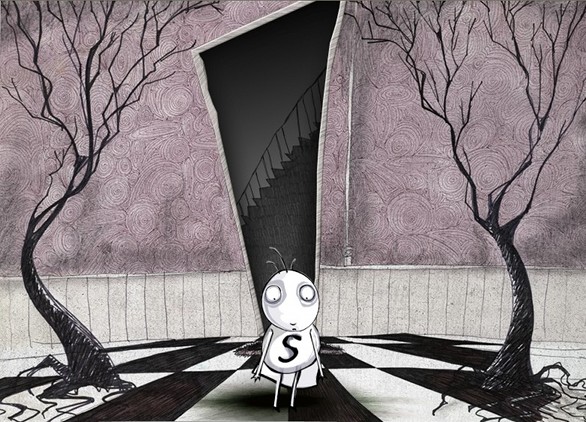
Tim Burton has embarked on an experiment in participatory art. Has invited users of Twitter to write a new story starring Stainboy, the character animation in flash The Melancholy Death of Oyster Boy & Other Stories.


Connecting to Twitter Profile
Cadavre Exquis any Twitter user can add to the history of a sequence, starting with the last typed. It is being born and then a great story of an artist collective that began Nov. 22 and in the course of development until December 6. For now, no one really knows whether Burton will use the script to make an animation, it is pretty busy shooting the new movie, "Dark Shadows" with Johnny Depp.
The nice operation, mostly serves as a springboard for the major retrospective that the Moma is dedicated to the author of Nightmare Before Christmas.
Finally back in Italy, with a thought Mario Monicelli .
Anche chi non conosce tutti i suoi film, deve (e sottolineo DEVE) sapere l’entità della Supercazzola.
Il termine è un neologismo che indica un nonsense, una frase priva di alcun senso logico, piena di parole inventate sul momento, usata per confondere colui al quale ci si rivolge, rendendolo ridicolo di fronte agli astanti.
L’origine del termine è il film Amici miei (1975), che racconta le vicende di un gruppo di amici burloni che si divertono a corbellare il prossimo e fare zingarate fuori porta. È soprattutto Ugo Tognazzi , nei panni del conte Raffaello Mascetti, a “usare” la supercazzola, investing the victim of the hoax with a barrage of incomprehensible words, often seasoned with disguised foul language. Here's the scene
debut of this myth:


Although some may find it just a gimmick comedy, it has historical antecedents of the distinguished.
According to Wikipedia, the first evidence of this paradigm of expression goes, in all likelihood, the Boccaccio. The Decameron (Third Day, Eighth Novella) it says:
"Then said Ferondo:
- Oh, how are we to far from our lands?
- Ohioh! - Said the Monaco - by far sevvi of miles of well-cache.
- Gnaffe! Cotesta is quite good - said Ferondo "
and again (Eighth Day, Three Novella):
" quoth Calandrino
- was you ever? To which Mason replied
- The 'you if I was' Why? Yes, there have been so once, like a thousand.
quoth Calandrino
- and how many miles do you have?
Maso said
- Haccene over misrepresent that sings all night. "
In both cases, the aim is of course, to confuse and deceive the victim party. Another likely source of inspiration can be identified in the Dispute between Mr. de 'Baciaculi and Mr. de' Pantagruel Fiutapeti that appears in [1], monumental novel published in 1532 by Francois Rabelais. The dispute consists of two gibberish from the typical form of prayers, legal, and the sentence which is solved by the protagonist. The episode is delicious in the translation of Augusto Frassineti. In his daring experimentalism, Rabelais is perhaps the source of many other witty word games.
A more recent historical antecedent in Gulliver's Travels (Gulliver’s Travels, 1735) in cui l’autore, Jonathan Swift, per burlarsi dell’abuso dei termini marinareschi incomprensibili alla maggior parte dei lettori dei racconti di avventure, inserisce nel primo capitolo della seconda parte un’intera pagina di parole tratte dal linguaggio dei marinai e dei costruttori navali del tutto priva di significato per gran parte dei lettori.
Nell’opera Don Giovanni di Wolfgang Amadeus Mozart (1787, libretto di Lorenzo Da Ponte) il servo Leporello, imbarazzatissimo, deve rivelare a una delle vittime del suo padrone la realtà del suo agire di seduttore senza sentimenti, ed esordisce con: “Madama… veramente… in questo mondo / Conciòssiacosaquandofosseché ... / The picture is not round ... "(Act One, Scene Five).
Thanks Mario, ec'hai reason, it would take the Revolution scappellamento ... with the right, as if Antani. :D